
The DUPR Obsession
When a Number Starts Running the Game

D = Dumb
U = Uninformed
P = Pickleball
R = Rubbish
Strong words? Maybe. But after nearly four years immersed in this incredible sport, I’ve watched something slowly creep in—and it’s not making the game better. It’s the obsession with DUPR. 😠
Let’s be clear: the DUPR system wasn’t created with bad intentions. It was designed by clever algorithm-driven minds to bring structure to competitive play. Tournament organisers needed a way to group players, create fair matchups, and give some sense of progression—particularly at the higher levels of the game. That all makes sense. But somewhere along the way, something shifted. What started as a useful tool has seeped into everyday recreational pickleball and begun to distort why people play the game in the first place.
Because here’s the truth: nobody ever picked up a paddle and said, “I’d love a sport where I can be assigned a fluctuating number and judged against others.” No. We picked up pickleball because it was fun, accessible, welcoming, and gave us connection, laughter, and that addictive feeling of improvement. It was never about the number.
And yet now, I hear things on court that genuinely concern me: “Oh no, my DUPR will go down.” and “I can’t play that match—it’ll affect my rating.” or “I need to be on a higher court to improve my DUPR.” as well as “Sorry, I won’t partner with you for this one.” We’ve reached a point where players are choosing partners based not on enjoyment, learning, or community—but on risk management of a rating. That’s not healthy, and it’s not what this sport was built on.
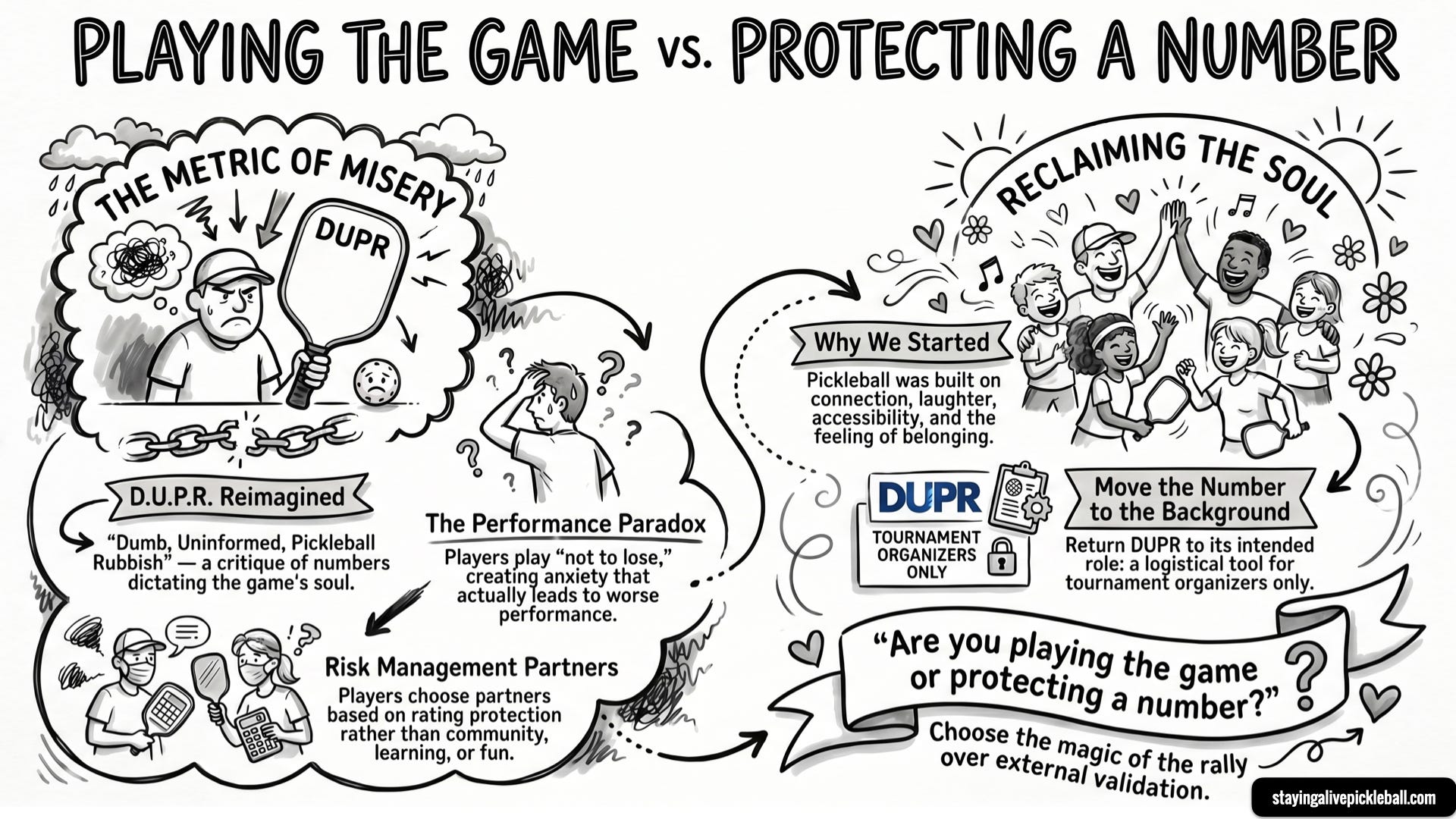
What’s worse is the psychological impact. Players are tightening up, overthinking, and playing not to lose rather than playing to express themselves. The joy is being replaced by anxiety. Ironically, that tension leads to worse performance—which often results in the very thing they feared: their rating dropping. It becomes a self-fulfilling loop.
So what are we really dealing with here? At its core, this isn’t about DUPR. It’s about something deeper: our relationship with how we’re perceived. As Carl Jung once suggested, “The privilege of a lifetime is to become who you truly are.” But that’s difficult when we’re constantly measuring ourselves against external validation. Sigmund Freud also explored how sensitive we are to social judgement and approval. We are wired to care what others think. Add a visible, trackable number into that mix, and suddenly your identity as a pickleball player feels quantified.
That’s where the danger lies. Because a number doesn’t capture your growth. It doesn’t reflect your effort. It doesn’t measure your courage to try new shots. It doesn’t show your contribution to the community. And it certainly doesn’t define your worth.
So here’s a challenge: what if DUPR went back to being what it was intended for—a background tool for organisers—rather than a front-and-centre measure of self-worth? What if we chose games based on connection, challenge, and enjoyment instead of rating protection? What if we remembered why we started?
Because the magic of pickleball has never been in a number. It’s in the laugh after a mishit, the battle in a long rally, the shared respect across the net, and the feeling of belonging. So next time you step on court, ask yourself: are you playing the game… or protecting a number? Because one of those will keep you coming back for years—and the other might just take the joy away.
More information via: stayingalivepickleball.com
👋 ~ Michael
Michael, I've been teaching pickleball since 2018 and I see this every week. Players in the 3.5 range stop experimenting because DUPR punishes it. So they protect points instead of building skills and then wonder why they're stuck. The number was supposed to serve the player. Somewhere it flipped.
I think there's real audience overlap between our readers, and I wondered if you'd be open to a potential collaboration, maybe a recommendation swap to start, and we could explore other ideas from there. No pressure either way, just wanted to reach out because I really enjoy your work.